
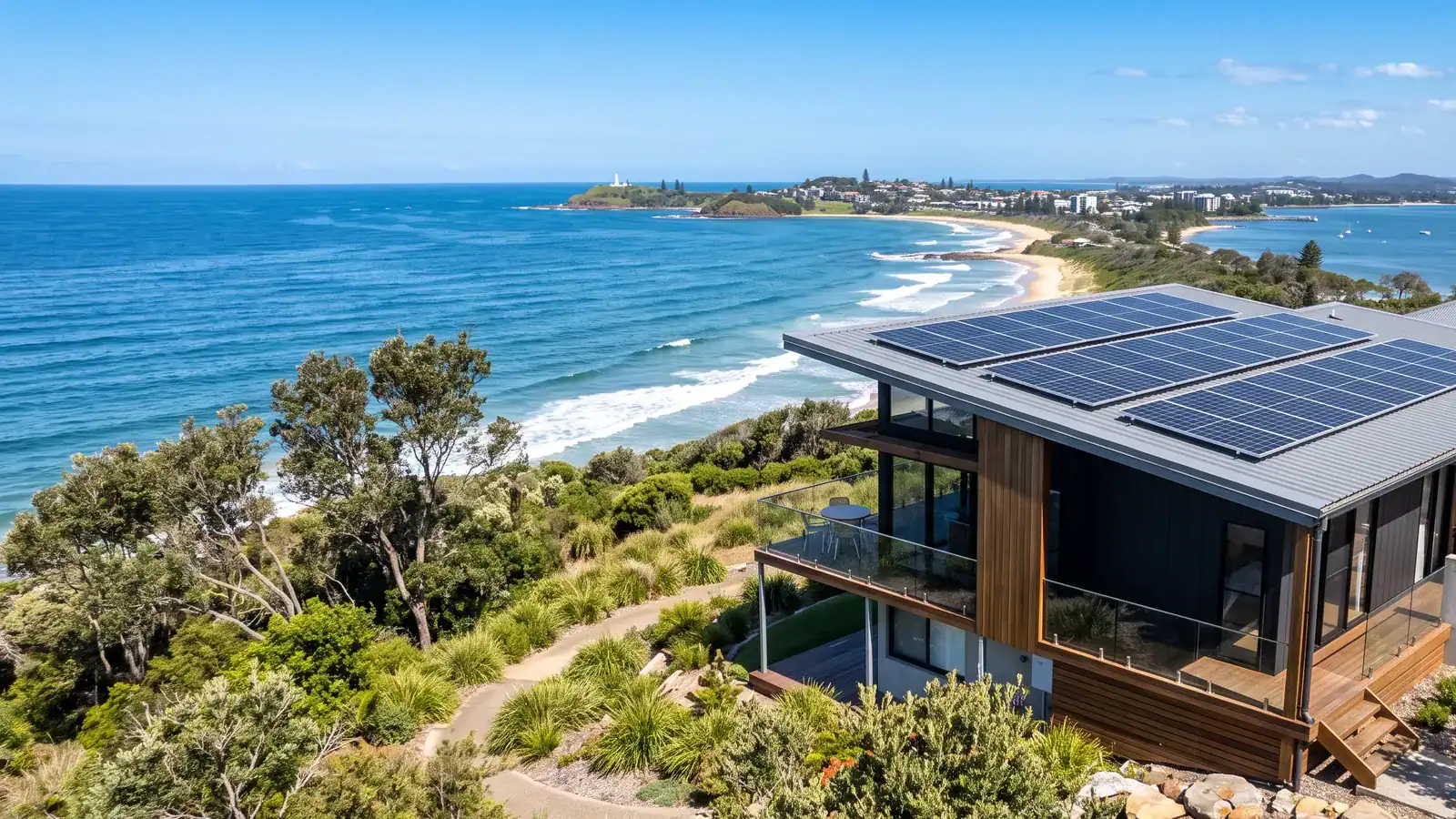
Port Macquarie gets over 230 sunny days a year, making it one of the best spots in NSW for rooftop solar.
Homeowners across the Mid North Coast are switching to solar faster than almost anywhere else in regional NSW. With average electricity prices sitting between 25 and 38 cents per kilowatt hour in the Port Macquarie area, a well-sized solar system knocks thousands off annual power bills from day one.
This guide covers everything you need to know about going solar in Port Macquarie. System sizes, real costs, government rebates, batteries, and what to look for in a local installer.
Already know you want solar? Check out SolaXs solar packages for Port Macquarie or request a free quote.
Why Port Macquarie Gets More From Solar
Port Macquarie sits in one of Australia’s better solar zones, with 4.8 to 5.5 peak sun hours per day depending on the season. That translates to roughly 25 to 30 kilowatt hours of daily generation from a standard 6.6kW system during summer, and 15 to 18kWh through winter. The warm-temperate climate means panels operate efficiently year-round without the extreme heat that actually reduces output further inland.
North-facing roofs perform best here, with an optimal tilt angle of around 31 degrees from horizontal. East-west splits are increasingly popular for households that use most of their power in the morning and afternoon. If your roof faces northeast or northwest, you will still capture 90% or more of the available sunlight.
- Peak sun hours: 4.8 to 5.5 per day
- Sunny days: 230+ per year
- Optimal panel angle: 31 degrees, north-facing
- East-west splits: Work well for morning and afternoon usage patterns
- Climate advantage: No extreme heat penalty that reduces panel efficiency in western NSW
The short version: Port Macquarie’s solar conditions are genuinely excellent. You can check your own area’s solar resource on the Australian Government’s energy website.
What Size Solar System Suits a Port Macquarie Home
Most Port Macquarie households install a 6.6kW system, which covers the average electricity bill comfortably. A family of four using 20 to 25kWh per day will offset most of their consumption, especially if they run the dishwasher, washing machine, and pool pump during daylight hours.
| Household Size | Daily Usage | Recommended System | Approximate Annual Savings |
|---|---|---|---|
| 1-2 people | 10-15 kWh | 3kW to 5kW | $800 to $1,200 |
| 3-4 people | 20-25 kWh | 6.6kW | $1,400 to $1,800 |
| 4-5 people | 25-35 kWh | 10kW | $1,800 to $2,200 |
| Large home or pool | 35+ kWh | 13.2kW | $2,200 to $2,500 |
Savings vary based on your retailer, tariff structure, and how much solar you self-consume versus export. For a more detailed breakdown by household type, see our guide on what size solar system suits a four bedroom house.
If you have a pool, ducted air conditioning, or plan to add an EV charger, go bigger than you think you need. Upgrading later costs more than doing it right the first time.
How Much Does Solar Cost in Port Macquarie
Prices have dropped significantly over the past five years. For a quality system with tier-one panels and a reputable inverter, expect to pay roughly the following after the federal STC rebate (including GST):
These are approximate guides and vary by property, system size, and installer. We go deeper in our full breakdown of solar panel costs in Port Macquarie.
The payback period for most homes here sits between three and five years. After that, your electricity is essentially free for the remaining 20+ years of panel life.
Be cautious of quotes under $3,000 for a 6.6kW system. Cheap systems typically use budget inverters that fail within five years and panels with limited real-world warranty support in Australia.
Government Rebates for Solar in Port Macquarie
The main financial incentive is the federal Small-scale Technology Certificate (STC) scheme, administered by the Clean Energy Regulator. Your installer claims the STCs and applies the discount at point of sale, so you pay the reduced price upfront.
For Port Macquarie (postcode 2444), a 6.6kW system generates a set number of STCs based on the remaining years in the scheme. In 2026, that discount works out to roughly $1,400 to $1,800 off the sticker price depending on certificate values at the time of installation.
- Your system generates a set number of STCs based on its size and your location
- Your installer claims the STCs and applies the discount at point of sale
- You pay the reduced price upfront, no rebate application needed
The STC scheme reduces each year and closes entirely on 31 December 2030. Every year you wait, the rebate shrinks.
NSW does not offer a separate state solar panel rebate. However, the federal Cheaper Home Batteries Program, which opened in mid-2025, provides upfront discounts and interest-free loans for eligible households adding battery storage.
Should You Add a Solar Battery in Port Macquarie
Batteries make sense if you use most of your power in the evening and your retailer offers poor feed-in tariffs. Brands like BYD, Sigenergy, and Goodwe all offer residential storage options that pair well with existing solar on the Mid North Coast. For a broader look at how home storage works, see our explainer on what solar batteries are and whether they suit your setup.
With the federal battery rebate and NSW VPP incentive combined, battery costs have dropped by $3,000 to $5,000 for a standard 10kWh unit. That changes the payback equation significantly compared to even two years ago.
- Add a battery if your feed-in tariff is under 5c/kWh
- Add a battery if you want blackout protection during storm season
- Skip the battery (for now) if your feed-in tariff is above 8c/kWh and you are home during the day
Picking a Solar Installer on the Mid North Coast
Not all installers are equal, and the Mid North Coast has plenty to choose from. Here is what actually matters when comparing quotes.
- CEC accreditation: Non-negotiable. Required for STC rebates and consumer protection. Check on the Clean Energy Council website.
- Local presence: A local team means faster warranty service and no travel surcharges for maintenance.
- Panel and inverter brands: Look for tier-one panels (Canadian Solar, Jinko) paired with quality inverters (Fronius, Goodwe).
- Workmanship warranty: Separate from panel and inverter warranties. Should be at least 5 years.
- Reviews: Check Google reviews, not just the installer’s own testimonials.
SolaXs has been installing solar on the Mid North Coast for over 25 years. CEC accredited, locally owned, and running tier-one panels with quality inverters across their standard packages. If any claims you hear during the quoting process sound too good to be true, check them against our rundown of solar myths that still fool Australians.
What to Expect During Installation
A typical residential solar install in Port Macquarie takes one to two days once the paperwork is sorted. The process runs roughly like this:
- Site assessment: Your installer visits the property, checks your roof structure, switchboard, and shading to design the right layout.
- System design and quoting: You receive a detailed proposal with panel placement, expected output, and pricing.
- Installation day: Panels go on the roof, the inverter is mounted, and everything is wired into your switchboard.
- Connection and commissioning: Your installer submits the connection paperwork to your retailer and the distribution network. Once approved, the system goes live.
Timing matters less than you might think here. Panels produce well year-round in Port Macquarie, though installing before summer means you capture the highest-output months straight away. For more on seasonal timing, see our guide on the best time of year to install solar in NSW.
Keeping Your Solar System Running
Solar panels need very little upkeep, but they are not completely set-and-forget. Dust, bird droppings, and salt air along the Mid North Coast can reduce output if left unchecked. A rinse with a garden hose every few months and an annual check of your inverter display keeps things on track.
For a full checklist, read our guide to solar panel maintenance for Australian homeowners.
If your panels are underperforming or your inverter is showing fault codes, SolaXs offers solar maintenance and repair services across the Mid North Coast. Homes with older systems may also benefit from a solar system upgrade to newer panels and inverters with higher output.
Getting Started
Port Macquarie’s solar conditions are hard to beat. Strong sun hours, a mild climate, and federal rebates that are still worth claiming mean most homeowners see a full return on their investment within three to five years.
If you are ready to get a quote, get in touch with SolaXs for a free assessment based on your roof, your bills, and your household. Or browse solar installation options to see what suits your home.
Solar in Port Macquarie FAQ
How long does a solar installation take in Port Macquarie?
Most residential solar installations are completed in one to two days. The paperwork and grid connection approval from your electricity retailer and distribution network can take an additional one to three weeks.
Do I need council approval to install solar panels?
In most cases, no. Solar panel installations on residential roofs in the Port Macquarie-Hastings local government area are exempt development under NSW planning rules, provided the panels do not protrude more than 100mm above the roof surface and the property is not heritage-listed. Your installer handles the electrical and grid connection paperwork.
What happens to my solar system during a blackout?
A standard grid-connected solar system shuts down during a blackout for safety reasons. Power must not feed back into the grid while line workers are repairing faults. If you want power during outages, you need a battery system with backup capability from brands like BYD or Sigenergy, both of which offer units with built-in backup switching.
Can I add a battery to my existing solar system?
Yes, most modern inverters are battery-ready, and even older systems can be retrofitted with an AC-coupled battery. The federal Cheaper Home Batteries Program makes adding storage more affordable than it was a few years ago. Check with your installer whether your inverter supports direct battery connection or whether you need a hybrid inverter upgrade.
What feed-in tariff can I get in Port Macquarie?
Feed-in tariffs in NSW are set by your electricity retailer, not the government. Rates typically range from around 3 to 12 cents per kilowatt hour depending on your plan. The lower the feed-in tariff, the more important it is to self-consume your solar during the day or store it in a battery for evening use.
How much roof space do I need for solar panels?
A standard 6.6kW system uses around 16 panels and needs roughly 30 square metres of unshaded roof space. Larger systems like a 10kW or 13.2kW setup need proportionally more. Your installer will assess available roof area and shading during the site visit.