
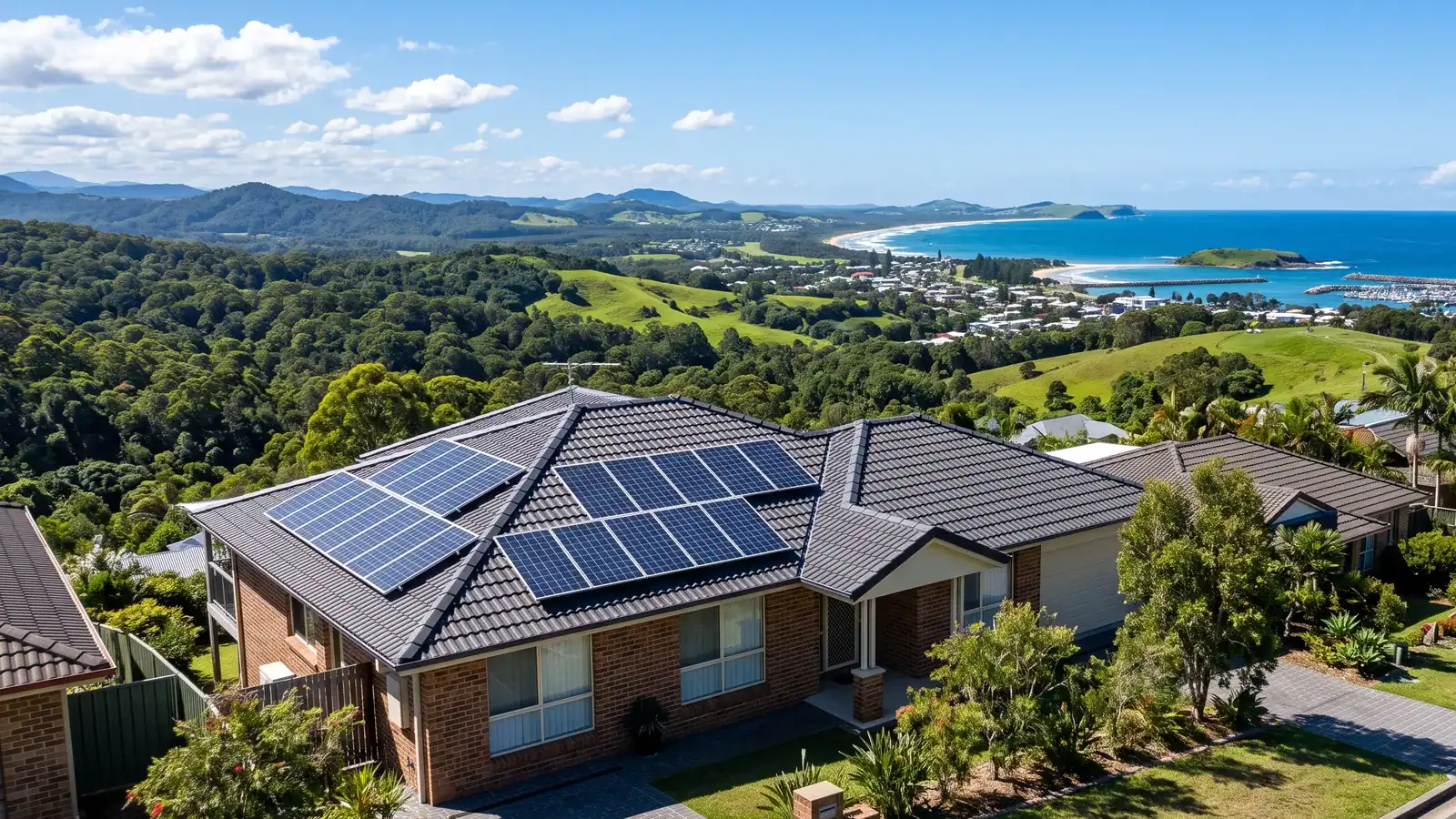
Solar in Coffs Harbour can reduce the electricity you buy from the grid, but the right design starts with your roof and when you use power.
A proposal for a residential solar installation matched to your electricity use should estimate generation and savings for your roof. A suburb-wide promise about bill savings cannot account for shading, evening loads or your electricity plan.
This guide covers local solar conditions, system sizing, rebates and what to check when choosing an installer.
Planning a local installation? Check what SolaXs offers in Coffs Harbour, then have your recent electricity bills ready for a site assessment.
Why Coffs Harbour suits solar
The Bureau of Meteorology’s Coffs Harbour Airport climate records show mean daily solar exposure of 17.0 MJ per square metre across the year.
That is approximately 4.7 kWh of sunlight energy per square metre per day, calculated by dividing by 3.6.
Sunlight on a horizontal surface is not the same as electricity delivered by rooftop panels. Your roof’s direction, shade and equipment losses affect how much electricity your panels produce.
- Check shade from trees, neighbouring buildings and roof features.
- Compare the available roof faces with your daytime electricity use.
- Ask for equipment and mounting suitable for the property’s coastal exposure.
- Allow for access and future roof repairs before covering the roof with panels.
For households on the Mid North Coast, a site assessment is more useful than assuming every nearby home will produce the same result. A clear roof near the coast and a shaded hinterland property need different designs.
How many sun hours does solar in Coffs Harbour get?
Peak sun hours express sunlight energy as equivalent hours at standard solar intensity. Using the BOM figures above, Coffs Harbour’s annual average is about 4.7 peak sun hours, with a lower solar resource in winter.
The table converts the airport’s monthly solar exposure records into equivalent peak sun hours. These are climate averages, not guaranteed panel output or hours of clear skies.
| Period | Mean daily solar exposure | Equivalent peak sun hours |
|---|---|---|
| January | 22.4 MJ/m² | About 6.2 |
| June | 10.7 MJ/m² | About 3.0 |
| Annual average | 17.0 MJ/m² | About 4.7 |
Source: the BOM airport records linked above; equivalent hours calculated as MJ/m² divided by 3.6. Ask your installer for monthly generation estimates that account for your actual roof, rather than multiplying these figures into a guaranteed daily yield.
What size solar system suits a Coffs Harbour home?
The right system size depends on electricity consumption and usable roof space. Start with the daily kWh on your bill, then check how much you use while the sun is out.
If everyone is away during the day, much of your production may be exported. A household running a pool pump, home office or daytime air conditioning may use more of its generation directly.
- A 6.6kW solar package for a smaller household is one option to assess against your daytime loads.
- A 10kW solar package for higher electricity demand warrants checking if you have more usable roof space and significant loads.
- A 13.2kW solar package for a larger home needs a design that explains how the additional generation will be used.
If you are considering home solar batteries for storing daytime generation, include evening usage in the assessment. Planning an EV charger installation for charging at home also means checking when the car will be available to charge.
Size for your routine. A bigger array does not automatically deliver better value. Ask your installer to show how much solar electricity you are expected to use at home, store in a battery and export.
Solar rebates available in Coffs Harbour
Incentive information last updated 7 October 2026. Eligible rooftop solar installations can receive small-scale technology certificates under the federal Small-scale Renewable Energy Scheme. Assigning these certificates to a registered agent commonly reduces the upfront price.
The scheme ends in 2030, and the remaining deeming period affects solar certificate entitlement. A quote should state the certificate discount separately because its dollar value depends on the installation details and the certificate price offered.
- Check the installed price before and after the certificate discount.
- Ask which installation date and certificate entitlement the quote assumes.
- Confirm eligibility and who handles the certificate assignment.
- Keep feed-in tariff credits separate from the upfront installation discount.
Battery support is separate from the solar panel calculation. The Clean Energy Regulator’s battery rules apply a factor of 6.8 certificates per eligible usable kWh for May to December 2026, with reduced support on capacity above 14 kWh.
The tiers apply progressively to each portion of usable capacity: the factor applies at 100% up to 14 kWh, 60% for capacity above 14 up to 28 kWh, and 15% above 28 up to 50 kWh. The factor is not a guaranteed dollar discount: ask for an eligibility check and a discount calculation based on your planned installation date. Source: Australian Government battery certificate guidance.
The NSW virtual power plant incentive may also help eligible battery owners. Compare provider offers and check when the provider can draw power from your battery and how much charge it will leave for your household.
Best roof setup for solar in Coffs Harbour
North-facing panels usually produce the most electricity over the day. East and west-facing roof areas can better match morning or afternoon loads, as explained in the Australian Government’s solar roof design guidance.
| Roof direction | When it may suit | What to check |
|---|---|---|
| North | Higher total daily generation | Shade and available roof area |
| East | Morning electricity use | Morning shade |
| West | Afternoon electricity use | Afternoon shade and roof layout |
| South | Some designs with limited alternatives | Roof slope and whether lower output justifies the cost |
Ask the installer to assess shading through the seasons. For a coastal property, also ask whether the proposed equipment’s warranty has salt-exposure conditions and whether the mounting arrangement suits the site.
How to pick a solar installer in Coffs Harbour
Compare the design and support behind the price. The Australian Government’s installer selection guidance confirms that Solar Accreditation Australia now operates installer accreditation, replacing the CEC accreditation scheme in May 2024.
- Check the named installer’s current accreditation and relevant electrical licence.
- Ask who takes responsibility for warranty claims and follow-up visits.
- Compare product warranties with the separate workmanship warranty.
- Look for recent customer reviews and examples of local work.
- Check the exact panel and inverter models, not just the brand names.
When comparing panels such as Canadian Solar and Jinko, or inverters from Goodwe and Fronius, ask why the proposed model suits your roof and electrical setup. The model still needs to suit your roof and electrical setup.
SolaXs is based in Port Macquarie and has 25+ years of experience. For a SolaXs installation in Coffs Harbour, ask how site visits, installation scheduling and warranty support will be handled.
Comparing solar quotes and payback estimates
A useful quote explains the whole installed cost. Roof access, switchboard work, metering arrangements and battery backup equipment can change what you pay.
- Request a roof layout and monthly generation estimate.
- Check which electrical work and metering costs are included or excluded.
- Ask for the assumed electricity tariff, export tariff and proportion used at home.
- Check payment terms, quote expiry and the process if the design changes.
Payback is an estimate based on the installed cost and expected annual savings. It should include the household’s likely use of solar, ongoing charges and any finance costs, rather than assume every generated unit replaces grid electricity.
Adjusting household routines to use more solar power can help you make better use of daytime generation. Compare the whole electricity plan too: a higher export rate may come with higher usage or daily supply charges.
Getting started with solar in Coffs Harbour
Your installer should explain the steps from assessment to commissioning. For Coffs Harbour homes on its network, Essential Energy’s solar connection guidance says the approved export limit is recorded in the connection contract’s site-specific conditions.
- Arrange a roof, shading and electrical assessment.
- Review the proposed equipment, layout and full installed cost.
- Confirm network approval and export conditions before installation.
- Arrange installation, commissioning and any required metering changes.
- Keep the manuals, warranties and connection documents, and learn how to read the monitoring app.
Panel capacity and permitted export are different things. An export limit caps power sent to the grid; ask how it has been allowed for in the savings estimate.
If an existing system needs attention, solar maintenance and repairs for an existing installation may be worth assessing before replacement. If your household’s needs have changed, discuss solar system upgrades matched to your new electricity needs and any fresh network approval required.
Frequently asked questions about solar in Coffs Harbour
Does solar work well in Coffs Harbour during winter?
Solar still generates in winter, but there is less sunlight than in summer. Ask for monthly estimates for your roof so you can see how winter shade and shorter days affect production.
How much does solar cost in Coffs Harbour?
The installed cost depends on the proposed equipment, roof access and electrical work. Compare itemised quotes for the same scope and check that the certificate discount and excluded costs are clear.
Can solar cover all my household electricity use?
Annual generation matching annual consumption does not mean every load is covered when it occurs. Evening use still needs grid power or stored energy, and cloudy periods affect production.
Do I need a battery with new solar panels?
No, a grid-connected solar system can operate without a battery. A battery may suit a household with spare daytime solar electricity and high evening use. Compare its installed cost with the savings you expect.
Will solar keep working during a blackout?
A standard grid-connected solar system shuts down during a grid outage. The Australian Government guidance on backup power explains that you need equipment configured for independent operation; ask exactly what the proposed setup can power.
Can I add panels to my existing system?
Possibly, after checking the existing inverter, roof space and electrical installation. Essential Energy requires a new connection application and approval before increasing system size on its network.
For a proposal based on your Coffs Harbour roof and electricity use, request a free solar quote from SolaXs. Bring recent bills and mention any plans for a pool, electric vehicle or battery so those loads can be considered.