
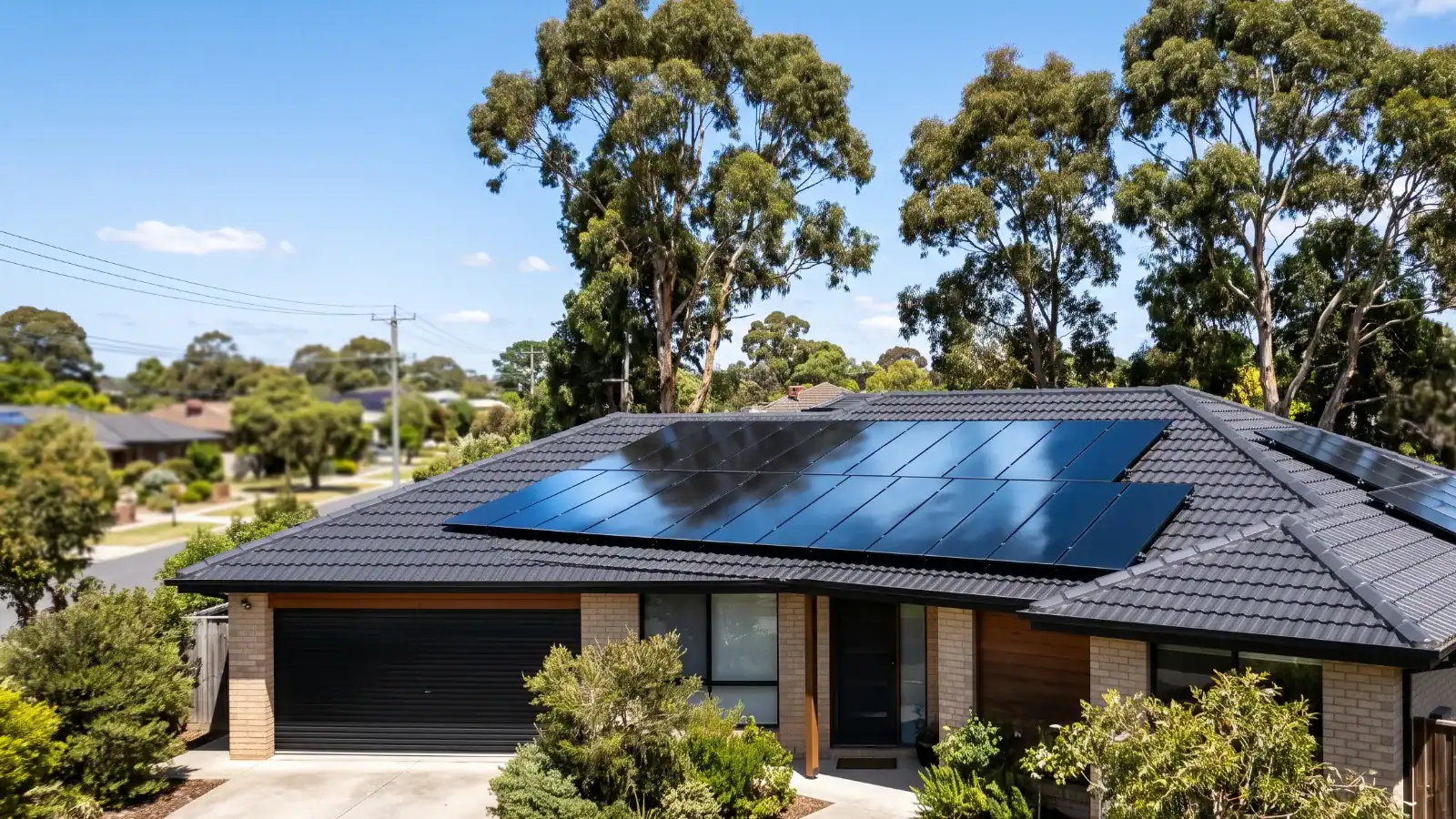
REC solar panels cost more than most brands on the Australian market, but the specs and warranty back up the price.
If you are comparing panel brands for a rooftop system, REC is a name that keeps turning up on installer shortlists. The Norwegian-founded company manufactures its panels in Singapore, as its manufacturing overview explains.
Below is a straight look at what REC panels deliver, how they handle heat, what the warranty covers, and whether the premium stacks up against other brands you can get on the Mid North Coast.
Already decided on solar? See the REC panels SolaXs installs or jump to our residential solar installation page for a free quote.
Who Makes REC Group Solar Panels?
REC Group is the manufacturer behind REC solar panels. Its company profile records its founding in 1996 and Norwegian headquarters, with operational headquarters in Singapore.
The panels are made at an integrated Singapore facility with automated production and internal quality testing, according to REC’s factory overview. That identifies where the panels are made; it does not mean every raw material comes from the same factory.
- Founded in Norway in 1996; company background.
- Manufacturing: Singapore, using highly automated production.
- Cell technology: Heterojunction (HJT) across the Alpha range
- Lead-free: RoHS compliant on the Alpha Pure-R
Ask for the model number, its Australian datasheet and the warranty terms with your quote.
Roof layout, shade, inverter selection and installation quality all affect the value you get from a premium panel.
What REC Panel Models Are Available in Australia?
The review focuses on the Alpha Pure-RX and Alpha Pure-R, the two HJT ranges shown in REC’s product overview. Confirm local stock and the exact model suffix with your installer; a family name alone is not a complete specification.
What are REC solar modules?
REC solar modules are the finished rooftop panels, rather than individual solar cells. For example, the Alpha Pure-RX module combines HJT cells, glass, a frame and electrical connections into one unit.
When a quote says “REC solar modules”, ask which Alpha model and wattage it means. Compare the module dimensions and the proposed roof layout as well as the power rating, because a larger panel is not automatically the best fit around skylights or roof hips.
Alpha Pure-RX
The Alpha Pure-RX range covered here reaches 470W with maximum efficiency of 22.6%.
Its published module area is 2.08 m², so check the proposed layout rather than assuming higher wattage always saves roof space.
Hail and load figures need the exact datasheet and test conditions. REC’s linked US datasheet distinguishes a 35mm certification test from a 55mm hail stress test; the test method matters as much as the stated diameter.
Ask for the Australian model’s documentation before relying on a hail rating. A distributed load rating is not permission to walk on panels; installation and roof access must follow the manufacturer’s instructions.
Alpha Pure-R
The Alpha Pure-R tops out at 430W with 22.3% efficiency.
It shares the same HJT cell platform as the RX but in a slightly smaller format (1.93 m² vs 2.08 m²).
The Alpha Pure-R is also lead-free and RoHS compliant, which matters if environmental impact is part of your decision.
Good to know: REC previously sold the TwinPeak 5 series in Australia. That line used PERC cells rather than HJT. If your installer quotes a TwinPeak 5, ask whether the newer Alpha Pure-R is available as an alternative.
How REC Panels Handle Australian Heat
Solar panel output falls as cell temperature rises above the datasheet reference temperature. Cell temperature is different from the weather forecast: sunlight, wind and ventilation beneath the panel all affect it.
Using the Alpha Pure-RX power temperature coefficient of -0.24%/°C, a cell temperature of 45°C gives a calculated temperature-only loss of 4.8% relative to 25°C.
That calculation from the published coefficient leaves 95.2% before other losses, assuming the same irradiance.
For a home in Port Macquarie and the surrounding Mid North Coast, this is useful when comparing quoted panels. It is not a forecast of daily energy or a promise of extra output on a 45°C day.
On a 10kW solar system, compare estimated annual generation for the same roof layout and inverter. That gives you a more useful basis for deciding whether the panel premium is justified than a single hot-day calculation.
- Compare the power temperature coefficient on each quoted datasheet.
- Use cell temperature, not ambient air temperature, in the calculation.
- Keep irradiance and all other assumptions the same when comparing panels.
- Treat ageing losses separately from temporary heat losses.
Salt air matters on the coast too. REC’s Pure-RX datasheet lists IEC 61701 salt-mist certification, but coastal suitability still depends on the exact module, mounting hardware and installation instructions.
If your house is near the shoreline around Port Macquarie, Coffs Harbour or the Hastings area, ask the installer to assess salt exposure and maintenance access. Certification is useful evidence, not a guarantee against every form of coastal damage.
REC Warranty Explained
REC offers a standard 20-year product warranty for the Alpha ranges reviewed here. REC ProTrust can extend product cover and add labour cover when an REC Certified Solar Professional installs and registers eligible panels; ask SolaXs to confirm eligibility in writing with your quote.
The Alpha Pure-RX performance warranty specifies at least 92% of nameplate power in year 25. This is a panel power warranty under stated conditions, not a guarantee that your whole system will generate a particular amount of electricity each year.
- Standard product cover: 20 years for these Alpha models, under REC’s warranty terms.
- ProTrust: installation by a certified professional plus registration; system-size limits apply.
- Performance: the datasheet warranty table states 98% in year one and 92% in year 25.
- Annual warranted degradation after year one: 0.25%, per the warranty table.
The catch: certification alone is not enough; registration and the applicable terms matter. Keep the invoice, model and serial numbers, commissioning documents and warranty confirmation where you can find them if you need to claim.
Regular solar panel maintenance for your home helps you spot issues affecting production. Dust, bird droppings and leaf shade can reduce output even when the panel itself is working normally.
If monitoring shows a persistent fall in generation, arrange professional solar maintenance and repairs before assuming the panels have degraded. The fault may be elsewhere in the system.
How REC Compares to Other Panel Brands
REC is not the only panel worth considering. Compare quotes for Jinko solar panels, Canadian Solar panels and Trina solar panels with the same inverter and installation scope; our Tindo solar panels review covers another option.
| Comparison point | REC Alpha Pure-RX / Pure-R | Other quoted panel brands |
|---|---|---|
| Roof fit | Compare the two Alpha formats against the usable roof area | Request dimensions and an actual panel layout |
| Heat performance | Check the model’s power temperature coefficient | Compare the same coefficient, not marketing descriptions |
| Warranty | Check standard cover and ProTrust eligibility | Check product, performance and labour cover separately |
| Durability | Obtain the Australian datasheet and mounting instructions | Compare test conditions as well as headline hail/load ratings |
| Installed cost | Ask what the premium adds to your particular system | Hold inverter, workmanship and quote exclusions constant |
The minimum warranted output after 25 years is useful, but it is only one part of the comparison. Model families change, and a brand-wide table can easily mix different wattages, generations or regional warranties.
Ask for a like-for-like comparison using the actual product codes on your quotes. For a wider shortlist, our rundown of the best solar panels for Australian homes covers more brands side by side.
What Do REC Panels Cost?
REC panels are generally positioned as a premium option, but an installed price per watt is only useful when the quote scope is clear. Ask SolaXs for the additional cost of the Alpha panels on your roof with the same inverter, mounting and electrical work.
For a 6.6kW solar system, the gap between panel options varies with the inverter, installer and your roof. Obtain itemised quotes so you can see what is included.
The incentive information below was last checked on 30 September 2026. Under the Clean Energy Regulator’s eligibility rules, approved products and an appropriately accredited installation are required for STCs; choosing a brand alone does not establish eligibility.
- Ask whether the quote includes switchboard work, access equipment and export-limit setup.
- Compare the final installed totals before and after any STC discount.
- Confirm the exact panel and inverter models are approved at installation.
- Request estimated generation and the assumptions used to calculate savings.
Our Port Macquarie solar panel pricing guide breaks down full system costs across different sizes if you want more detail on the numbers.
Are REC Panels Worth It for Mid North Coast Homes?
The Mid North Coast can suit rooftop solar, but a regional sunshine average is not a yield estimate for your house. Ask for an assessment that accounts for roof direction, pitch, seasonal shade and when you use electricity.
- Limited roof space: compare the panel layout and watts per square metre, not wattage alone. The larger Alpha format may fit fewer positions around hips, skylights or ventilation pipes.
- Coastal corrosion: check the module and mounting requirements for your exposure to salt air. Leave safe access for inspection and maintenance.
- Staying in your home long term: warranty support deserves more weight if you expect to keep the system for many years. A stronger power floor does not automatically mean a faster financial payback.
- Battery pairing: REC panels work well with home solar batteries to store excess daytime production for use in the evening. Battery compatibility depends on the inverter and system design, rather than the panel brand alone.
- Tight budget: compare the panel upgrade with other uses of the budget, such as improving the layout or addressing shade. Ask what each change does to estimated generation.
SolaXs can walk you through what makes sense for your roof and budget. Bring your electricity bills and any plans for a battery or electric vehicle so the recommendation reflects how you expect to use power.
Frequently Asked Questions
REC manufacture and performance
wp:html
Who makes REC solar panels?
REC Group makes the panels in Singapore. Its company profile describes Norwegian headquarters and Singapore operational headquarters; its factory overview confirms panel manufacturing in Singapore.
/wp:html
wp:html
How long do REC panels last?
The Alpha Pure-R warranty runs for 25 years on performance, with a 92% power floor at the end. That is a warranty period, not an expiry date; useful life depends on condition, installation and maintenance.
/wp:html
wp:html
How does REC compare to Jinko and Canadian Solar?
Compare the actual models offered, rather than treating every panel from a brand as identical. Ask for the power temperature coefficient, roof layout, warranty terms and installed price using the same inverter so you can judge the panel premium fairly.
/wp:html
wp:html
Are REC panels good for hot climates like Australia?
The Pure-RX coefficient is favourable for heat performance. Using its published coefficient, 45°C cell temperature gives a temperature-only output factor of 95.2%; this calculation does not describe output on a day with 45°C air temperature.
/wp:html
wp:html
REC warranty and buying questions
What is REC ProTrust warranty?
ProTrust is REC’s extended warranty programme for eligible, registered installations by certified professionals. REC explains that labour cover varies with system size and approved claims receive a fixed labour fee; confirm the applicable terms in your quote.
/wp:html
wp:html
Do REC panels qualify for the solar rebate?
An REC installation can qualify if the exact products and installation meet the current STC eligibility requirements. Check approved models and Solar Accreditation Australia accreditation; a brand name or a claim of “CEC-accredited installer” is not enough.
/wp:html
wp:html
Are REC panels worth the extra cost?
REC panels can be worth the premium, especially where the proposed layout works well and you value the warranty package. Ask how much extra you would pay and what extra generation is predicted; the power warranty alone cannot tell you whether the premium will pay for itself.
/wp:html
wp:html
What are the top 3 solar panels in Australia?
There is no single top three for every roof. For this REC review, the useful question is whether the quoted Alpha model gives you a better combination of roof fit, support and cost than the alternatives on your shortlist.
/wp:html
wp:html
What should I check before accepting an REC panel quote?
Ask for the full module code, Australian datasheet, roof layout, inverter compatibility and written warranty eligibility. Make sure the quote explains who registers the installation and who handles a warranty claim.
If you are replacing an older array, a review of solar system upgrades for your existing installation can establish whether the inverter and mounting can be retained. That affects the cost of choosing new panels.
/wp:html
The Bottom Line on REC Panels
REC makes a premium panel and charges for it. If you are keeping your home long term, the Alpha ranges deserve a place on your shortlist; check the layout and warranty package before paying extra.
- Ask for a roof-specific layout and generation estimate.
- Keep model documentation and warranty confirmation with your quote.
If you want to compare REC against other options for your roof, contact SolaXs for a solar quote. The local team can size the system and explain the price difference between panels.
You can also check how much solar panels actually save to understand the assumptions behind a savings estimate.