
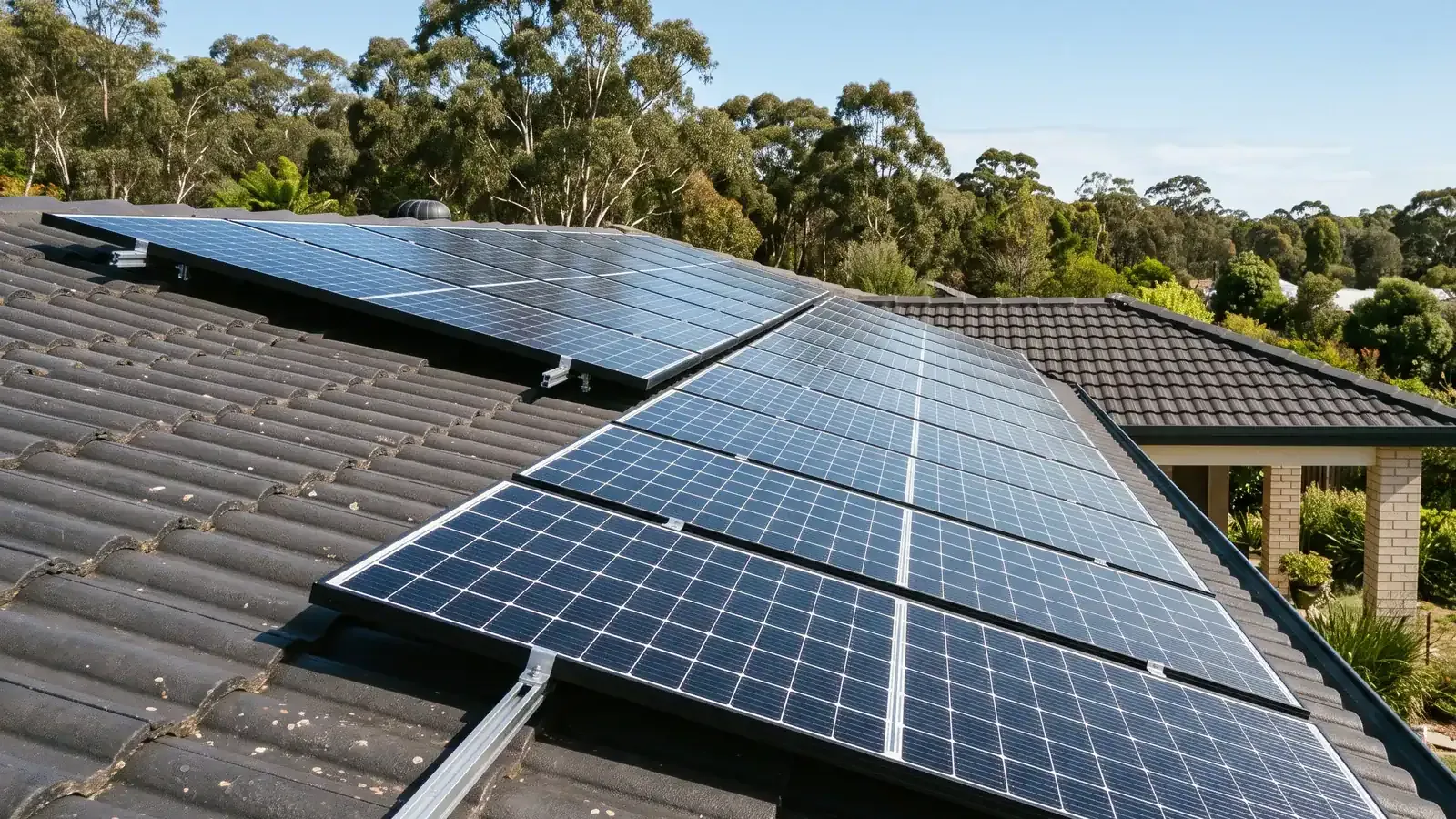
LONGi panels offer more warranty coverage and efficiency than their mid-range price tag suggests.
If you're shopping for solar panels, LONGi is a name that keeps coming up. LONGi Green Energy shipped over 63 GW of cells and modules in the first nine months of 2025, making it the world's largest solar manufacturer by volume.
We've compared LONGi's specs, warranty, and heat performance against Jinko, Canadian Solar, and Trina for homes on the Mid North Coast and across Australia.
Already know you want solar? Get a free quote from SolaXs or explore 6.6kW and 10kW solar system packages for Mid North Coast homes.
Who Makes LONGi Solar Panels
LONGi Green Energy Technology was founded in 2000 in Xi'an, China. LONGi Green Energy started making monocrystalline silicon wafers and now controls the full chain from raw silicon ingots through to finished panels.
Vertical integration means LONGi builds its own cells rather than buying them from third parties. The upside is consistency: panels from one batch perform the same as panels from the next.
LONGi Green Energy ships panels to over 150 countries. In Australia, LONGi panels are approved by the Clean Energy Council and qualify for Small-scale Technology Certificates (STCs), the federal rebate that brings upfront costs down.
- Founded: 2000 in Xi'an, China
- Speciality: Monocrystalline silicon, vertically integrated
- Global shipments: 63 GW in the first nine months of 2025
- Australian certification: CEC approved, STC eligible
With 63 GW shipped in nine months, LONGi is not going anywhere. That matters when you're counting on a 25-year warranty.
LONGi Panel Specs Worth Knowing
LONGi's residential range centres on the Hi-MO X6 series, which uses the company's proprietary HPBC (Hybrid Passivated Back Contact) cell technology. HPBC cells move all the electrical contacts to the rear of the cell, so nothing shades the front surface. The result is higher efficiency per square metre than standard PERC or TOPCon designs.
- Module efficiency: 21.3% to 23.3% across the Hi-MO X6 range
- Wattage: 420W to 590W depending on the model
- Cell type: HPBC (back-contact monocrystalline)
- Frame: Anti-dust edge frame design to reduce soiling losses
- Hail rating: Withstands 25mm hailstones at 23 m/s
- Wind load: 5,400 Pa frontal, 2,400 Pa rear
For a typical 6.6kW system, you'd need around 15 to 16 Hi-MO X6 panels at 420W each. A 10kW system uses roughly 24.
How LONGi Panels Handle Australian Heat
Solar panels lose output as they heat up. Every panel drops efficiency above 25 degrees Celsius, but the rate of loss varies by brand. LONGi's Hi-MO X6 panels have a temperature coefficient of -0.29% per degree Celsius, which is better than the industry average of around -0.35%.
The newer Hi-MO X10 series drops that figure further to -0.26% per degree Celsius.
On the Mid North Coast, roof temperatures regularly hit 60 degrees Celsius in summer. At that temperature, a standard panel loses roughly 12% of its rated output. A LONGi Hi-MO X6 loses closer to 10%. Two percent sounds small, but over a full summer it adds up.
Coastal homeowners take note: LONGi recommends installing panels at least 50 metres from the waterline. Salt spray accelerates corrosion on any panel frame, and LONGi's warranty excludes damage from installations closer than 50 metres.
For homes in Port Macquarie, Coffs Harbour, and surrounding areas, that heat tolerance translates to a few extra kilowatt-hours per day during the hottest months.
LONGi Warranty Breakdown
LONGi offers a 25-year product warranty and a 30-year performance warranty on the Hi-MO X6 range. The product warranty covers manufacturing defects, while the performance warranty guarantees minimum output at specific milestones.
- Product warranty: 25 years
- Performance warranty: 30 years
- First-year degradation: Maximum 1%
- Annual degradation after year one: 0.4% per year
- Guaranteed output at year 25: 88.9% of rated capacity
- Guaranteed output at year 30: 88.85% of rated capacity
Most Tier 1 panels offer 25-year performance warranties guaranteeing 80% to 84.8% output. LONGi promising 88.9% at year 25 with an extra five years of coverage on top is noticeably better than the pack.
LONGi also has an Australian office in Sydney. If you need a warranty claim handled in year 15, you're dealing with a local team rather than chasing emails to an overseas head office.
LONGi vs Jinko, Canadian Solar and Trina
Choosing between Tier 1 panel brands often comes down to specs, warranty terms, and what your installer carries. Here is how LONGi compares against three other popular brands available on the Mid North Coast.
| Feature | LONGi Hi-MO X6 | Jinko Neo | Canadian Solar | Trina Vertex N |
|---|---|---|---|---|
| Cell technology | HPBC (back-contact) | TOPCon N-type | TOPCon N-type | TOPCon N-type |
| Efficiency range | 21.3% to 23.3% | 21.0% to 22.8% | 21.0% to 22.5% | 21.0% to 22.5% |
| Temp coefficient | -0.29%/°C | -0.30%/°C | -0.34%/°C | -0.29%/°C |
| Product warranty | 25 years | 25 years | 25 years | 25 years |
| Performance warranty | 30 years (88.85%) | 30 years (87.4%) | 25 years (83.1%) | 25 years (83.5%) |
| Hail rating | 25mm at 23 m/s | 25mm at 23 m/s | 25mm at 23 m/s | 25mm at 23 m/s |
LONGi's HPBC technology gives it an efficiency edge, and the 30-year performance warranty with 88.85% guaranteed output is the strongest in this group. Jinko's Neo range is the closest competitor on warranty length, though the guaranteed output at year 30 is lower.
All four brands are CEC approved and qualify for STCs. The real difference often comes down to which panels your installer has direct supply agreements with and can support locally.
What LONGi Panels Cost in Australia
LONGi panels sit in the mid-range price bracket for Tier 1 solar. Pricing varies depending on system size, inverter pairing, and installer margins, but expect to pay roughly $0.25 to $0.40 per watt for the panels alone.
For a fully installed system using LONGi panels, market pricing typically ranges from $4,500 to $7,500 for a 6.6kW system and $7,000 to $11,000 for a 10kW system after STCs. Pricing includes panels, inverter, mounting, wiring, and installation labour.
Prices are approximate market guides only and vary by property, system size, and installer. Contact SolaXs for an accurate quote tailored to your roof.
- Panel-only cost: Roughly $0.25 to $0.40 per watt
- 6.6kW system installed (after STCs): Typically $4,500 to $7,500
- 10kW system installed (after STCs): Typically $7,000 to $11,000
LONGi sits between budget panels and premium options like REC or Tindo. You get a 30-year performance warranty at a mid-range price, which is hard to match elsewhere.
Pros and Cons of LONGi Panels
Every panel has trade-offs. Here are LONGi's.
Strengths
- Industry-leading 30-year performance warranty with 88.85% guaranteed output
- HPBC cell technology delivers higher efficiency than most TOPCon panels
- Strong heat tolerance with a -0.29%/°C temperature coefficient
- Vertically integrated manufacturing means consistent quality batch to batch
- Australian office in Sydney for local warranty support
- Anti-dust edge frame reduces soiling losses between cleans
Weaknesses
- 50-metre coastal exclusion zone limits installations near the waterline
- Not the cheapest option if budget is the only consideration
- Fewer residential panel sizes compared to Jinko or Trina's broader lineup
- HPBC technology is newer, so long-term field data beyond 10 years is limited
The coastal exclusion applies to all panels to some degree. LONGi just states theirs clearly, which is better than brands that bury it in fine print.
Are LONGi Panels the Right Choice for Your Home
LONGi panels make sense for homeowners who want strong warranty coverage and solid efficiency without paying premium prices.
On the Mid North Coast, LONGi's heat tolerance is a real plus. The panels pair well with inverters from Fronius, Goodwe, and Sungrow, all of which SolaXs installs and services locally as a CEC-accredited installer.
Contact SolaXs for a free quote on a solar system sized to your home. With 25 years of residential solar installation experience on the Mid North Coast, the team can walk you through which panels and inverter pairing will deliver the best return for your roof.
Frequently Asked Questions
Where are LONGi solar panels made?
LONGi Green Energy manufactures panels in China (Xi'an) and Malaysia (Kuching), plus several other sites across Southeast Asia. LONGi Green Energy owns the full production chain from silicon ingot to finished module.
How long do LONGi solar panels last?
LONGi's Hi-MO X6 panels carry a 25-year product warranty and a 30-year performance warranty. LONGi guarantees at least 88.85% of rated output at the 30-year mark, which is among the strongest guarantees you'll find on a mid-range panel.
Are LONGi or Jinko panels better?
LONGi and Jinko are both Tier 1 manufacturers with strong track records. LONGi's HPBC cell technology offers slightly higher efficiency (up to 23.3%) compared to Jinko's TOPCon cells (up to 22.8%). LONGi also guarantees higher output at year 30 (88.85% vs 87.4%).
Jinko offers a wider range of residential panel sizes. The better option often depends on which brand your installer supports locally.
How do LONGi panels perform in extreme heat?
LONGi panels handle heat better than average. The Hi-MO X6 has a temperature coefficient of -0.29% per degree Celsius, compared to the industry standard of around -0.35%. On a 60-degree roof in summer, LONGi panels lose about 10% of rated output versus 12% for panels with the standard coefficient.
Can I install LONGi panels near the coast?
LONGi recommends a minimum 50 metre setback from the waterline. Salt spray corrodes frames and connections, and installations within that zone may void the warranty. Ask your installer about marine-grade mounting if your home is close to the water.
What size LONGi system suits a typical Australian home?
Most go with 6.6kW (about 16 Hi-MO X6 panels at 420W) or 10kW (about 24 panels). Your electricity usage and roof space will determine which fits, and whether adding a battery makes sense down the track.