
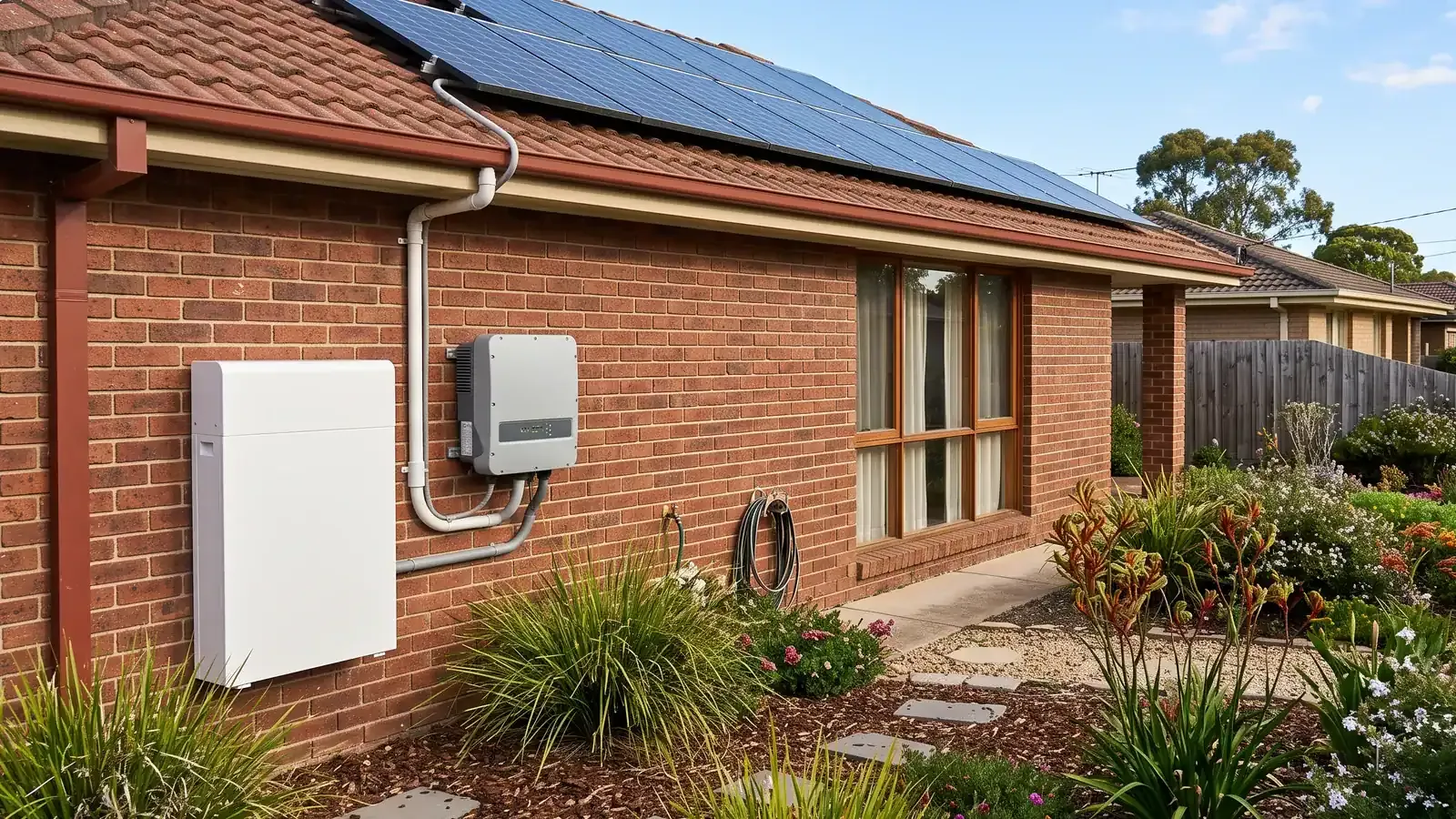
BYD home batteries come in four ranges, and the right one depends on your overnight energy use and inverter setup.
The BYD Battery-Box lineup spans a compact 5.1 kWh unit for a two-person household through to a stackable 22.1 kWh system built for families running heat pumps and EV chargers. Every model uses lithium iron phosphate (LFP) cells. The range splits into high voltage and low voltage classes, and each class pairs with a different set of inverters.
This guide compares every BYD home battery sold in Australia side by side. Specs, installed pricing, government rebates and which model actually fits different household sizes on the Mid North Coast.
Already decided on BYD? Read our full BYD Battery-Box review for warranty deep dives and real-world feedback, or browse the best solar batteries for Australian homes to compare other brands.
What BYD Home Batteries Are Available in Australia
BYD sells three home battery ranges in Australia: the Battery-Box Premium HVS, HVM and LVS. A fourth range, the LVL, targets commercial and large off-grid installations rather than typical houses. All four use LFP chemistry. LFP eliminates thermal runaway risk and lasts longer than nickel manganese cobalt (NMC) cells.
The high voltage models (HVS and HVM) pair with hybrid inverters from Fronius, Goodwe and SMA. The low voltage LVS pairs with off-grid inverters like Victron and Selectronic. Pick the voltage class that matches your inverter first, then choose the capacity.
| Model | Usable Capacity | Modules | Voltage Class | Best For |
|---|---|---|---|---|
| HVS | 5.1 to 12.8 kWh | 2 to 5 | High | Smaller homes, budget entry point |
| HVM | 8.3 to 22.1 kWh | 3 to 8 | High | Medium to large homes |
| LVS | 4.0 to 24.0 kWh | 1 to 6 | Low | Off-grid, Victron/Selectronic setups |
| LVL | 15.4 kWh+ | 1+ | Low | Commercial, large off-grid |
BYD HVS vs HVM for Australian Homes
The HVS uses 2.56 kWh modules stacked in groups of two to five, reaching a maximum 12.8 kWh. The HVM uses slightly larger 2.76 kWh modules in groups of three to eight, maxing out at 22.1 kWh. Both share 96% round-trip efficiency and the same 10-year warranty.
If your household draws 8 to 12 kWh overnight, a 10.2 kWh HVS will handle it comfortably. That covers most two-person homes.
Families pulling 15 to 25 kWh after dark, especially with ducted air conditioning or an electric vehicle on charge, want the HVM. The 16.6 kWh HVM is the size most installers recommend for a four-person home.
HVM modules cost less per kWh than HVS modules. At current market rates, HVM pricing sits around $650 to $850 per kWh installed, while HVS runs $1,100 to $1,400 per kWh. If you need 10 kWh or more, the HVM is almost always better value.
- HVS 5.1 to 12.8 kWh: lower upfront cost, suits lighter overnight loads, 2 to 5 module stacks
- HVM 8.3 to 22.1 kWh: better per-kWh value, handles heavier loads, 3 to 8 module stacks
- Both ranges: identical LFP chemistry, 10-year warranty and 96% efficiency
These are ballpark market figures. Your actual installed price depends on the inverter, cabling and site access.
When a Low Voltage BYD Battery Makes Sense
The BYD LVS runs at 51.2V nominal and connects to off-grid or hybrid inverters that need a low voltage DC input. Victron MultiPlus, Selectronic and SMA Sunny Island are the most common pairings in Australia.
You'd pick the LVS if your property already runs a Victron or Selectronic off-grid system and you want to add battery storage without swapping the inverter. It also works well for new off-grid builds where 48V architecture gives more flexibility for generator integration.
- LVS 4.0 to 24.0 kWh: 1 to 6 modules, supports up to 16 parallel units for commercial scale
- Best paired with: Victron, Selectronic, SMA Sunny Island
- Not ideal for: standard grid-connected homes where high voltage models lose less energy in conversion
For standard grid-connected homes, the HVS or HVM is a better fit. High voltage systems lose less energy in DC-DC conversion, and the compatible inverter range is wider.
How to Size a BYD Battery for Your Household
Battery sizing starts with your evening and overnight electricity draw, not your solar panel output. Oversizing wastes money on capacity that never discharges. Undersizing puts you back on the grid by 8pm.
- 2-person household (8 to 12 kWh overnight): BYD HVS 10.2 kWh or HVM 8.3 kWh
- Family of 4 (15 to 20 kWh overnight): BYD HVM 16.6 kWh
- Large family or EV charging (20 to 30 kWh overnight): BYD HVM 22.1 kWh or two HVM stacks in parallel
- Off-grid property: BYD LVS 16.0 to 24.0 kWh paired with a Victron or Selectronic inverter
On the Mid North Coast, daily solar generation averages 4 to 5 peak sun hours. A north-facing 10 kW solar system paired with a 16.6 kWh BYD HVM covers most four-person households through winter months.
Not sure? Start with a smaller stack. Both HVS and HVM allow expansion by adding modules to the existing base unit, and you can run up to three parallel stacks if demand grows.
What BYD Home Batteries Cost With Government Rebates
BYD battery pricing varies by model, installer and location. The table below shows typical fully installed cost ranges at current market rates.
| Model | Installed Cost Range | Cost per kWh |
|---|---|---|
| HVS 10.2 kWh | $11,000 to $14,500 | $1,100 to $1,400 |
| HVM 11.0 kWh | $7,200 to $9,400 | $650 to $850 |
| HVM 16.6 kWh | $10,800 to $14,100 | $650 to $850 |
| LVS 16.0 kWh | $10,500 to $13,500 | $660 to $840 |
Prices are approximate market guides only and vary by property, system size and installer. Contact SolaXs for an accurate quote.
The federal Small-scale Renewable Energy Scheme provides Small-scale Technology Certificates (STCs) that reduce battery purchase costs at the point of sale. On a 16.6 kWh HVM, the STC discount typically knocks around $3,900 off the installed price. NSW households may also access additional savings through the Energy Security Safeguard scheme.
The federal STC rebate reduces each year as the scheme's deeming period shortens. Installing sooner captures more certificates and a larger discount. Rebate information current as of August 2026.
How BYD Compares to Tesla Powerwall and Sungrow
BYD, Tesla and Sungrow are the brands we see most often on Mid North Coast rooftops. Here's how their mid-range models stack up.
| Feature | BYD HVM 16.6 kWh | Tesla Powerwall 3 | Sungrow SBR 16.0 kWh |
|---|---|---|---|
| Usable capacity | 16.6 kWh | 13.5 kWh | 16.0 kWh |
| Chemistry | LFP | LFP | LFP |
| Modular | Yes (add modules) | No (sealed unit) | Yes (add modules) |
| Warranty | 10 years, 60% capacity | 10 years | 10 years |
| Round-trip efficiency | 96% | 97.5% | 96% |
| Typical cost per kWh | $650 to $850 | $700 to $900 | $600 to $800 |
BYD Battery-Box's biggest advantage over Tesla Powerwall 3 is modularity. A Powerwall is a sealed 13.5 kWh unit, so stepping up to 27 kWh means buying a second Powerwall. BYD lets you add individual 2.76 kWh modules to reach exactly the capacity you need without overpaying.
Sungrow SBR matches BYD on modularity and sits at a similar price point. The deciding factor is usually inverter brand.
Sungrow batteries pair best with Sungrow hybrid inverters. BYD works with a wider range including Fronius, Goodwe and SMA. For a full breakdown, read our Tesla Powerwall vs BYD Battery-Box comparison.
BYD Warranty, Safety and Maintenance
Every BYD Battery-Box Premium carries a 10-year warranty guaranteeing at least 60% of original usable capacity. The warranty also caps total energy throughput at roughly 3,000 kWh per kWh of rated capacity, which works out to about one full cycle per day over the warranty period. BYD rates the LFP cells for 6,000 cycles at 80% depth of discharge.
- Safety: LFP chemistry doesn't suffer thermal runaway. Safe for garage or indoor wall mounting
- Operating temperature: rated from -10 to 50 degrees Celsius, well within Australian conditions
- Maintenance: no regular servicing required beyond keeping the unit clear of debris and checking the inverter connection annually
- Registration: the warranty requires registration through your installer within 60 days of commissioning
SolaXs is CEC accredited and has been installing solar battery systems around Port Macquarie and the Mid North Coast for over 25 years. Get in touch if you want help matching a BYD battery to your setup.
BYD Home Batteries FAQ
Are BYD home batteries any good?
Short answer: yes. BYD Battery-Box LFP cells are rated for 6,000 cycles at 80% depth of discharge, which is a lot of nightly use before they wear down. BYD is the world's largest EV battery manufacturer, and each Battery-Box carries a 10-year warranty covering at least 60% of original capacity.
How much do BYD home batteries cost in Australia?
Installed pricing typically ranges from $650 to $1,400 per kWh depending on the model. A 16.6 kWh HVM system usually costs between $10,800 and $14,100 fully installed before government rebates. Prices are approximate market guides only and vary by property, system size and installer.
What inverter works best with a BYD battery?
High voltage models (HVS and HVM) pair with Fronius GEN24, Goodwe ET series, SMA Sunny Boy Storage and several others. Low voltage models (LVS) pair with Victron, Selectronic and SMA Sunny Island. Check BYD's compatibility list or ask your installer.
How many BYD battery modules do I need?
Match module count to your overnight electricity draw. A two-person household typically needs three to four HVM modules (8.3 to 11.0 kWh). A family of four usually needs five to six modules (13.8 to 16.6 kWh).
Larger households or those charging an EV should look at seven to eight modules (19.3 to 22.1 kWh).
Can I expand a BYD battery later?
Yes. Both HVS and HVM allow you to add modules to an existing base unit without replacing any hardware. You can also run up to three parallel stacks for larger capacity. The LVS supports up to 16 parallel units for commercial-scale storage.
Does a BYD battery provide backup power during blackouts?
That depends on the inverter, not the battery. If your hybrid inverter supports backup switching (most Fronius GEN24 and Goodwe ET models do), the BYD battery will power your home during grid outages. Confirm backup support with your installer during the quoting stage.