
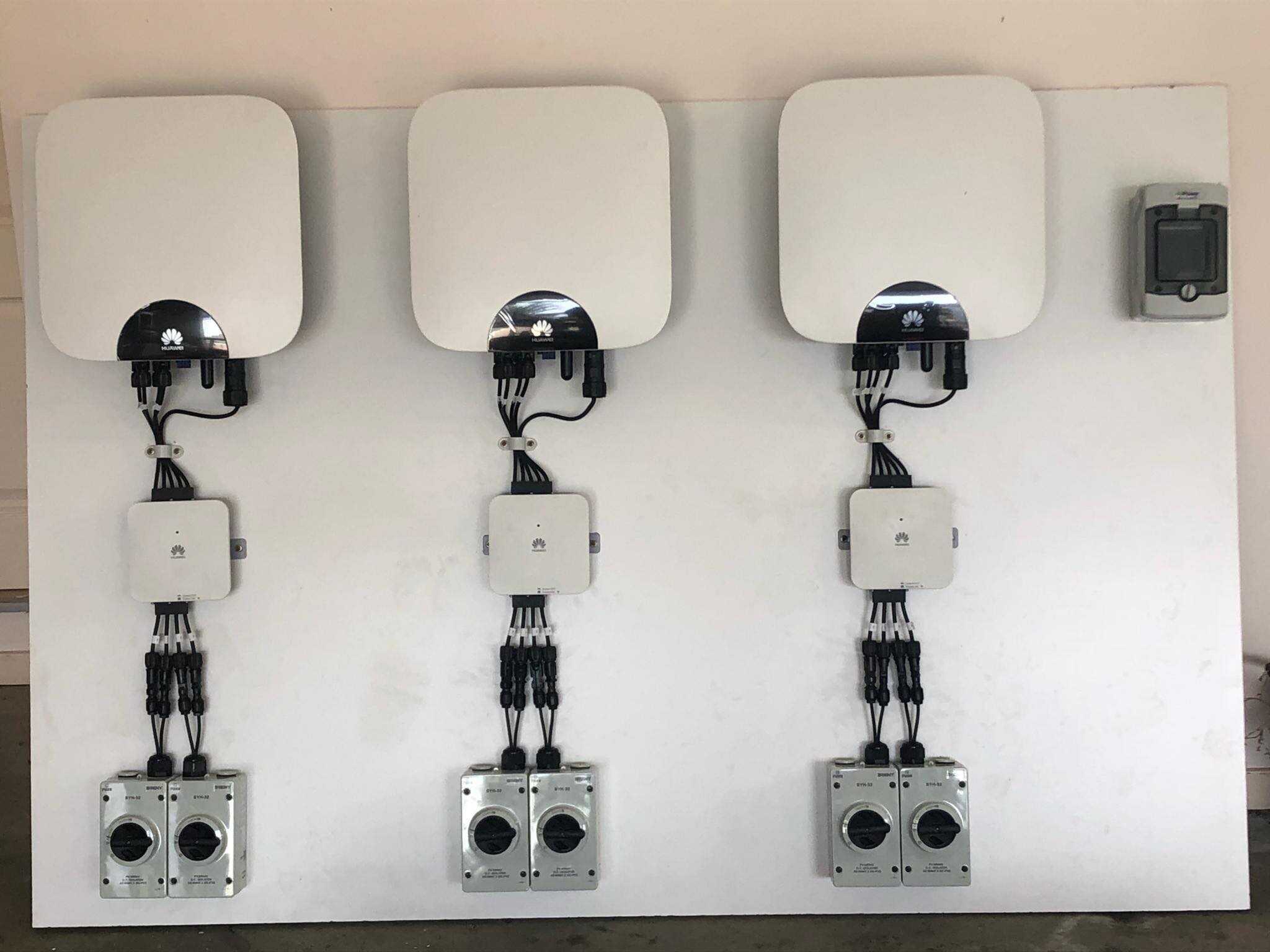
A 3 phase hybrid inverter lets you run solar, battery storage, and grid power across all three phases of your home.
If your home has a 3 phase power supply and you want batteries, a three-phase hybrid is one option. Australian Government inverter guidance confirms that a single-phase inverter can also suit a three-phase property, but its blackout backup serves only circuits on that phase.
This guide covers what a 3 phase hybrid inverter does, how it differs from a standard inverter, and what to look for when choosing one. SolaXs installs 3 phase hybrid systems with battery storage across the Mid North Coast, including solar installations in Port Macquarie.
Want to talk through your options? Contact SolaXs for a free consultation, or browse the solar packages available for 3 phase homes.
What Is a 3 Phase Hybrid Inverter
A 3 phase hybrid inverter converts DC power from solar panels into AC power and distributes it across all three phases of your electrical supply. The “hybrid” part means it also manages a connected battery, charging from solar during the day and discharging at night.
A standard solar inverter supplies household loads and sends excess power to the grid. A hybrid can store excess solar in a compatible battery, reducing what you buy from the grid after dark.
A 3 phase hybrid inverter handles:
- Solar conversion from DC panels to AC household power
- Battery charging and discharging based on your usage patterns and time-of-use tariffs
- Grid export when the battery is full and the house is not using power
- Grid import when the battery is empty and solar is not producing
- Three-phase output within the inverter’s total and per-phase limits; unbalanced-load capability depends on the model
- Backup power during blackouts (on models with backup capability)
Homes with 3 phase power may have large or simultaneous loads. Running ducted air conditioning on solar, alongside a pool pump, EV charger or induction cooktop, means your installer should check how much power these appliances draw together and which phase each one uses.
3 Phase Hybrid vs Standard Solar Inverter
A standard solar inverter only converts solar DC to AC. It has no battery port and no ability to store energy for later use.
A hybrid inverter adds a battery connection and controls charging and discharging alongside the battery’s management system. Blackout protection needs a suitable model, a compatible battery and the specified backup wiring, as outlined in government guidance on hybrid inverters.
| Feature | Standard 3 Phase Inverter | 3 Phase Hybrid Inverter |
|---|---|---|
| Solar conversion | Yes | Yes |
| Battery connection | No (needs separate battery inverter) | Built-in DC battery port |
| Blackout backup | No | Yes (on most models) |
| Export limiting | Available with suitable controls | Model-specific; requires metering and configuration |
| Future battery ready | Requires additional hardware | Compatible batteries only; activation may be required |
| Efficiency comparison | Check model datasheet | Compare solar conversion and battery round-trip efficiency separately |
If you plan to add a battery in the next few years, installing a hybrid now may avoid separate battery-inverter hardware later. If your existing solar inverter works well, an AC-coupled battery may let you retain it; compare both options before replacing equipment.
How to Size a 3 Phase Hybrid Inverter
The inverter size needs to match your solar panel capacity and household loads. The inverter’s kW rating tells you how much power it can deliver at once. A battery’s kWh rating tells you how much energy it stores.
When pricing a 10 kW three-phase solar system, check the inverter rating separately from the panel capacity.
Panel oversizing must meet the inverter’s input limits. Australian Government system-sizing guidance says panel capacity must meet the manufacturer’s specifications for rebate eligibility; AS/NZS 4777.2 does not create a universal oversizing allowance.
A 10 kW solar package needs a design that also checks string voltage, input current and connection approval.
To work out the right size for your home, consider:
- Daily electricity usage from your last 12 months of bills
- Roof space and how many panels you can fit
- Battery size you plan to install now or later
- EV charging, if you have or plan to buy an electric vehicle
- Export limits set by your distributor
If you are unsure where to start, SolaXs can help you work out the right solar system size based on your bills and household loads.
On the Mid North Coast, Essential Energy’s fixed export guidance generally specifies 5 kW total for a single-phase or three-phase site, with lower limits possible. A higher limit requires assessment; your connection contract records the approved limit. Export capacity is separate from inverter capacity and the power you can use at home.
Battery Compatibility With 3 Phase Hybrid Inverters
Not every battery works with every hybrid inverter. Most 3 phase hybrids are designed for specific battery brands and chemistries.
The two main connection types are DC-coupled, where the battery connects through the hybrid inverter, and AC-coupled, where the battery has a separate inverter. Government guidance on DC-coupled systems explains why hybrids are an option when installing solar and batteries together; an integrated AC battery needs a different design.
Key battery compatibility factors:
- Voltage range that the inverter’s battery port supports
- Maximum charge and discharge rate
- Number of battery units the inverter can manage (expandability)
- Whether the battery brand is on the inverter manufacturer’s approved list
Pairing an inverter and battery from the same brand can simplify selection, but still check the exact model combination and firmware. A mixed-brand pairing must appear on the manufacturer’s compatibility list; a matching voltage alone is not enough.
Best 3 Phase Hybrid Inverter Brands in Australia
Several brands offer three-phase hybrids, but series names cover different generations. Use the model number on your quote to look up its Australian datasheet and warranty; the examples below are starting points, not a universal ranking.
| Model family | Output and backup | Battery pairing | Warranty check |
|---|---|---|---|
| Compare GoodWe three-phase hybrids in the ET family. ET inverter review | ET PLUS+ example: 5–10 kW, three-phase backup and unbalanced output. Manufacturer datasheet. | Lynx battery compatibility or approved third-party models; check the exact ET generation. | Australian terms list 5 years for ET 5–10 kW and 10 for ET G2; confirm any additional cover in writing. |
| Compare Sungrow three-phase hybrids in the SH-RT family. SH-RT inverter review | SH5.0/6.0/8.0/10RT: 5–10 kW, three-phase backup; per-phase limits apply. Manufacturer datasheet. | SBR battery options; confirm approved battery stack and firmware. | Listed SH-RT models have 10-year Australian inverter cover; check the model and service conditions. |
| Consider Fronius three-phase hybrids such as the Symo GEN24 Plus. Symo GEN24 Plus | 6–10 kW Full Backup examples require external switchover components. Australian datasheet specifies switching in seconds, not milliseconds. | Check BYD battery systems, including approved HVS/HVM configurations; Battery-Box compatibility review. | Australian warranty guidance offers up to 10 years with registration; check commissioning-date terms. |
| Consider Sigenergy three-phase controllers for an integrated battery design. SigenStor system review | Choose the TP controller rating for your loads; three-phase backup requires the appropriate gateway. | Matching modular battery system; confirm module count and usable capacity on the quote. | Ask for the current TP controller warranty certificate. A 15-year term must be evidenced by applicable extended cover, not assumed from the brand name. |
SolaXs can walk you through a detailed comparison based on your system size and battery plans. Ask who pays for diagnostic visits, removal, freight and replacement labour, and whether registration is required to activate the advertised warranty.
Blackout Protection on 3 Phase Hybrid Systems
Backup power during blackouts is one of the main reasons homeowners choose a hybrid inverter. Not all models offer the same level of backup, and 3 phase backup is more complex than single phase.
Backup capability varies by model and falls into three broad categories:
- No backup (some entry-level hybrids have no backup function at all)
- Single-phase backup where only one of the three phases stays powered during an outage, covering essentials like lights and the fridge
- Full 3 phase backup where all three phases stay live and the solar panels keep charging the battery during the outage
Three-phase backup can supply connected backup circuits on all three phases, but cannot promise every appliance will run together. Total output, per-phase output, motor starting demand and available battery power all matter; solar recharging during an outage also depends on the system design.
If blackout protection matters to you, ask the installer to list exactly which circuits will stay powered and test them at commissioning. A fridge and lights are a different requirement from running a three-phase ducted air conditioner through a storm outage.
- Can the backup output start your air conditioner or pump?
- What is the continuous limit on the busiest phase?
- How much battery charge is reserved for outages?
- Can solar restart and recharge the battery after it reaches its minimum charge?
- Will computers need a separate UPS during switchover?
How Much Does a 3 Phase Hybrid Inverter Cost
A 3 phase hybrid inverter costs more than a standard string inverter because of the battery management hardware and backup circuitry. Pricing varies by brand and capacity.
For a supply-only example, an Australian retailer lists the SH10RT inverter and metering bundle at $5,100 including GST. That listing is not a SolaXs quote or an installed-system price.
- Inverter, compatible battery and any activation fees
- Backup gateway or changeover hardware and circuit separation
- Switchboard work, cabling and metering
- Installation, commissioning and connection application
- GST, eligible discounts and warranty registration
Total installed cost including panels, battery and labour will be higher than a supply-only listing. Compare quotes with the same backup scope and battery capacity; the full breakdown of solar installation costs explains the other components.
Battery incentive guidance updated 13 October 2026.
The federal solar battery rebate may reduce eligible battery costs, but the program changed on 1 May 2026. Government eligibility requirements cover approved equipment, connection to solar PV and installation by an appropriately accredited installer; grid-connected systems must be VPP-capable, without compulsory VPP participation.
Ask for the discount calculated for your installation date; the supply-only price example above was checked on the update date.
Operating Modes to Check Before You Buy
A hybrid inverter’s settings decide when stored energy is used. Confirm the available modes for your model and tariff before relying on projected savings.
- Self-consumption: use solar at home, charge the battery with surplus, then discharge when solar falls.
- Time-of-use: schedule permitted charging and discharge around your electricity rates; include conversion losses when comparing costs.
- Backup reserve: hold charge for an outage, accepting that less energy is available for everyday bill savings.
- Export control: keep exports within the approved limit; VPP control may change how the battery operates.
For example, evening cooking and air conditioning compete for stored power, while a daytime pool pump can use solar directly. Planning EV charger installation around your solar supply helps decide whether the car should charge during daylight or off-peak hours.
For an existing solar system, compare solar system upgrades for battery compatibility with retaining the current inverter and adding an AC-coupled battery.
What a 3 Phase Hybrid Inverter Installation Involves
Installing a 3 phase hybrid inverter is more involved than a single-phase system. The electrician needs to wire the inverter to all three phases at the switchboard and configure per-phase export limits.
If you are adding home solar batteries at the same time, placement must suit cable limits, access and battery-installation requirements. Blackout protection requires the backup hardware specified for your model.
A typical installation includes:
- Obtaining distributor approval before installation, then completing commissioning paperwork
- Mounting the inverter on an external wall or in a garage
- Running DC cabling from the solar panels to the inverter
- Connecting the inverter to all three phases at the main switchboard
- Installing or configuring the meter for solar export
- Commissioning the inverter and monitoring app
Timing depends on switchboard work, batteries, backup hardware and network approval. Solar Accreditation Australia replaced CEC installer accreditation in 2024; confirm the installer’s current solar and battery credentials. SolaXs handles the connection paperwork as part of the installation design.
Get the Right 3 Phase Hybrid Inverter for Your Home
SolaXs has over 25 years of experience with residential solar installation on the Mid North Coast. The team can assess your 3 phase supply, recommend the right inverter, and handle the installation from design to connection approval.
Bring an electricity bill and any questions about battery storage, backup power, or charging your EV with solar. Ask SolaXs to compare your expected evening loads with the inverter’s backup limits.
Ask for a written design showing the selected inverter, compatible battery and backup circuits. Keep the equipment datasheets and warranty certificates with your quote.
Frequently Asked Questions
Do I need a 3 phase hybrid inverter if I have 3 phase power?
Not necessarily. A standard three-phase string inverter suits solar-only systems, while a hybrid supports compatible DC battery storage. Your choice depends on battery plans, network approval and which phases need blackout backup.
Can I use a single-phase hybrid inverter on a 3 phase home?
Yes, subject to network approval and system design. Government guidance on inverter phases confirms this option; single-phase blackout backup will serve only circuits connected to that phase. A three-phase hybrid is useful when you need an appropriately designed three-phase backup supply.
What size battery do I need with a 3 phase hybrid inverter?
Choose enough usable battery capacity for your evening and overnight electricity use, then check its discharge rating covers the appliances you want to run together. Holding charge for blackouts reduces what is available for daily use. How much solar batteries cost explains the budget implications.
Will a 3 phase hybrid inverter power my whole house during a blackout?
Only the circuits included in the backup design can be supplied, within total and per-phase power limits. A large battery does not remove an inverter’s output limit. Ask for a circuit schedule and a motor-starting assessment before expecting whole-home backup.
Costs, lifespan and future battery plans
Is a 3 phase hybrid inverter worth the extra cost over a standard inverter?
A hybrid can be worthwhile when a compatible battery is planned and the extra upfront cost avoids a separate battery inverter later. Compare that with an AC-coupled retrofit, especially if your current inverter works well. Backup capability and any activation charges should be priced explicitly.
How long does a 3 phase hybrid inverter last?
Warranty length is not a prediction of service life. Compare the exact model’s warranty, cooling and installation conditions, and budget for eventual replacement; solar inverter replacement costs depend on equipment and site work.
Does the federal battery rebate apply to 3 phase hybrid systems?
Eligible batteries can be paired with single-phase or three-phase equipment. The current federal eligibility rules require a suitable solar-connected battery system, approved equipment and appropriately accredited installation. Ask your installer to confirm eligibility and the discount for your installation date.
Can I install a 3 phase hybrid inverter without a battery?
Some models operate as grid-connected solar inverters before a battery is added, but confirm that option for the exact model. Check whether battery activation costs extra and which compatible batteries are available when you expect to expand.
Does a larger inverter mean a higher export allowance?
No. The distributor sets the export allowance separately from the inverter rating. Essential Energy’s connection guidance says the approved limit is recorded in your connection contract; a larger inverter does not automatically raise it.