
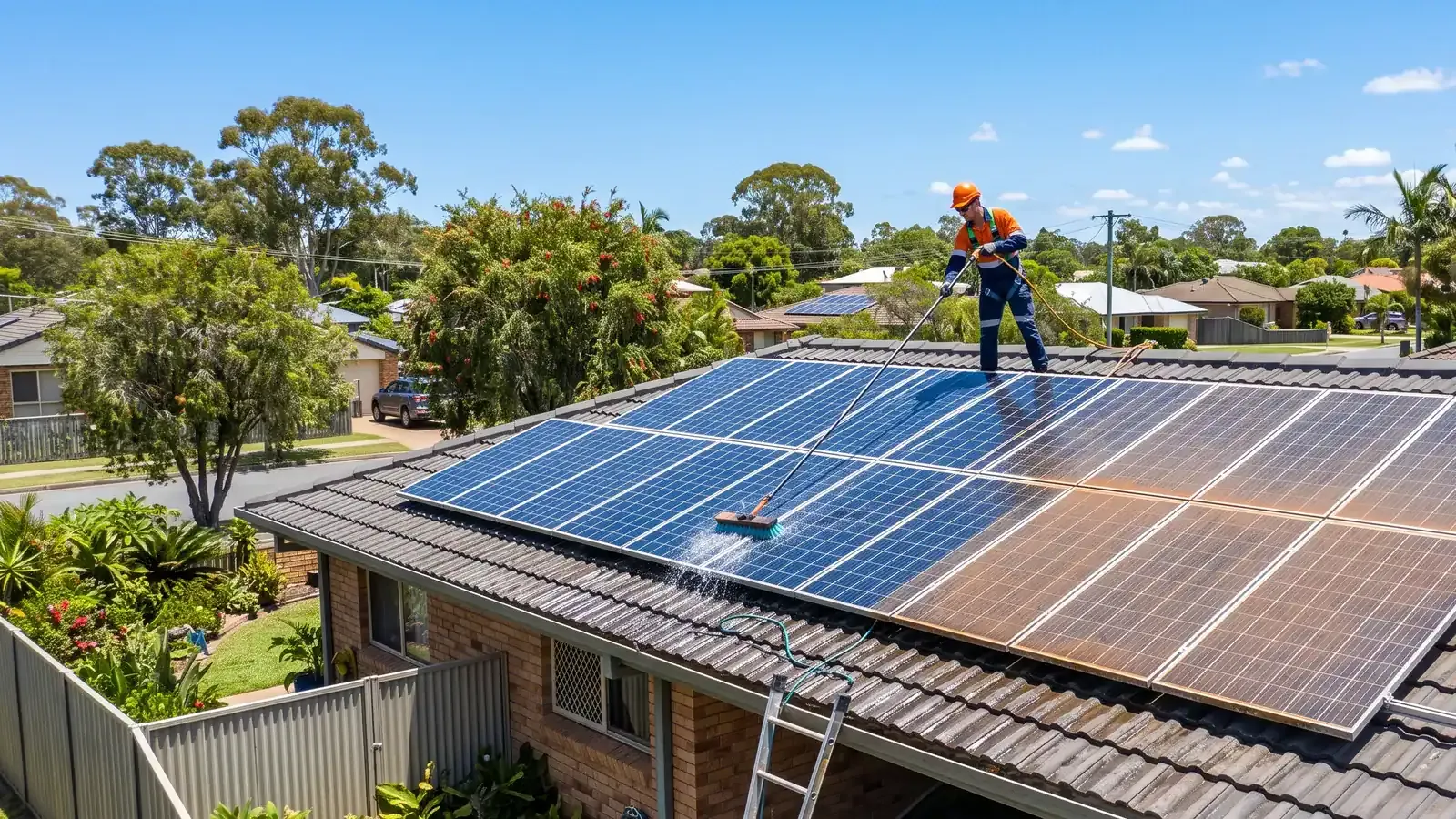
Most solar panels on a decent tilt in an area with regular rainfall barely need cleaning at all.
We tell our customers this upfront because the solar cleaning industry oversells the problem. Dirt and bird droppings do reduce output, and there are situations where a proper clean makes a measurable difference to your power bill. But for most homes on the Mid North Coast, rain handles most of it.
Below is the actual data on soiling losses, when cleaning pays for itself, and how to do it safely if your panels genuinely need it.
Already know your system is underperforming? The issue might not be dirt. Read our guide on troubleshooting solar inverter faults to rule out electrical problems first.
What Makes Solar Panels Dirty
Your panels collect everything the sky throws at them, not just sunlight. The type of soiling depends on where you live and what surrounds your house.
On the Mid North Coast, we see a mix of coastal and rural factors. Salt spray carries inland from the ocean and leaves a fine residue. Eucalyptus pollen coats panels in spring and early summer.
Bird droppings are the single worst offender. They bake on hard and block light completely wherever they land, creating concentrated hot spots on the affected cells.
- Dust and general grime build up slowly and spread evenly across the panel surface
- Bird droppings create hot spots that block individual cells entirely
- Pollen and leaf litter accumulate in autumn and spring, particularly under overhanging trees
- Salt spray from the ocean, reaching properties several kilometres inland on the Mid North Coast
- Lichen and mould in humid climates, though this takes years of neglect
Properties surrounded by bushland or farmland tend to get dirtier panels than suburban homes with clear sky exposure. Homes near Port Macquarie with tree cover or backing onto farmland are the most common cases we see.
How Much Power Do Dirty Panels Actually Lose
The Clean Energy Council uses a 5% soiling loss as the default assumption when designing solar systems in Australia. That covers a typical residential setup on a standard tilt with average rainfall.
Most homes lose somewhere between 2% and 10% depending on conditions. Research on tilted panels in coastal areas with regular rain has shown losses as low as 1%, while flat-mounted panels in dry conditions lose far more.
A 6.6kW solar system producing around 9,500 kWh per year at 32c/kWh loses roughly $152 per year at 5% soiling. At 2% soiling, the loss is about $61.
Professional cleaning typically ranges from $150 to $300 per visit across Australia. For a system only losing 2%, the maths does not stack up. Prices are approximate market guides only and vary by property, system size, and installer.
Panels under a roost of cockatoos or downwind from a dirt road can lose 20% or more, but that is not the norm for a suburban or coastal home.
Does Panel Tilt Angle Matter for Solar Panel Cleaning
Tilt angle matters more than anything else when it comes to self-cleaning. The Clean Energy Council specifies a minimum tilt of 10 degrees for effective rainwater runoff.
Water sheets off a tilted panel and carries dust with it. On a flat panel, water pools, evaporates, and leaves mineral deposits behind.
Google tested this at their Mountain View headquarters. Flat-mounted panels showed a 100% output improvement after cleaning following 15 months without maintenance. Panels on a standard tilt in the same location barely changed.
- Panels at 15 degrees or more generally self-clean with regular rainfall and rarely need manual cleaning
- Panels at 10 to 15 degrees benefit from an annual check but may not need cleaning
- Panels below 10 degrees or flat accumulate grime and need cleaning every 6 to 12 months
Most residential solar installations on the Mid North Coast follow the roof pitch, typically between 15 and 25 degrees. At that angle, moderate rainfall handles most of the cleaning.
When Solar Panel Cleaning Is Worth the Money
Here is where we lose a few potential cleaning customers. If your panels are on a standard tilt and your area gets reasonable rainfall, paying someone to clean them rarely makes financial sense.
| Situation | Likely soiling loss | Cleaning worth it? |
|---|---|---|
| Standard tilt, coastal/suburban, regular rain | 2-5% | Probably not (rain handles it) |
| Standard tilt, under trees or near birds | 5-15% | Yes, once or twice a year |
| Flat or low-angle panels | 10-25% | Yes, every 6-12 months |
| Rural/dusty area, near farmland | 10-20% | Yes, at least annually |
| Extended drought (no rain for 3+ months) | 5-15% | Yes, after the dry spell |
For a typical Mid North Coast home with panels on a pitched roof and reasonable rainfall, you could go two or three years without cleaning and barely notice the difference. What you should not ignore is bird droppings.
A single dropping on a cell creates a hot spot that reduces the output of the entire string of cells connected to it, not just the one cell it covers.
How to Clean Solar Panels Yourself
If your panels are accessible from the ground, you can clean them yourself without special equipment. Just never use anything abrasive or high-pressure. Solar panels have an anti-reflective coating that scratches easily.
Safe cleaning steps
- Clean in the early morning or late afternoon when panels are cool. Spraying cold water on hot glass risks thermal shock.
- Use a garden hose at normal pressure to rinse loose dust and debris off the surface.
- For stubborn grime or bird droppings, use a soft brush or sponge on an extension pole with plain water. No detergent.
- Rinse again with the hose and let the panels air dry.
What to avoid
- Pressure washers can crack glass and destroy the anti-reflective coating
- Abrasive sponges or scourers scratch the surface permanently
- Detergents and chemical cleaners leave residue that attracts more dirt
- Walking on panels can crack cells internally even if the glass looks fine
If your panels are on a steep or high roof, do not climb up to clean them. Falls from single-storey roofs cause serious injuries every year. Use a hose from the ground, hire a professional, or leave them to the rain.
Professional Solar Panel Cleaning vs DIY
Professional solar panel cleaning typically costs between $150 and $300 per visit for a standard residential system across Australia. Some installers bundle cleaning with a system health check, which adds value because they can spot wiring issues or inverter faults at the same time.
Prices are approximate market guides only and vary by property, system size, and installer. Contact SolaXs for an accurate quote.
| Factor | DIY | Professional |
|---|---|---|
| Cost | Free (garden hose + soft brush) | $150-$300 per visit |
| Safety | Ground-level only | Trained for roof work |
| Effectiveness | Good for light soiling | Better for heavy buildup |
| Warranty risk | Low if using water only | None (insured professionals) |
| Fault detection | No | Spots cracked panels, wiring issues |
Solar Victoria recommends a professional system service by a licensed electrician at least every two years. That service includes electrical testing and visual inspection, not just a wash. If you are due for a service, adding a clean to the visit is the most cost-effective approach.
How to Tell If Your Panels Need Cleaning
Skip the ladder and check your inverter monitoring app instead. Modern inverters from brands like Goodwe and Fronius have apps that show daily and monthly production, and a gradual decline in output is the clearest sign that dirt is costing you.
We had a customer in Wauchope last year convinced his panels were faulty. Turned out a family of lorikeets had been using his north-facing array as a bathroom for months.
- Compare month-on-month output for the same time of year. A 10% drop in January compared to last January is worth investigating.
- Check after a long dry spell. If output drops during dry weeks and recovers after rain, your panels are self-cleaning adequately.
- Look for visible bird droppings from the ground with binoculars. Even one or two droppings on the wrong cell can reduce a string's output.
If the drop is sudden rather than gradual, the issue is more likely an inverter fault or a tripped circuit breaker. Dirt causes slow, steady losses, not overnight drops.
The Bottom Line
- Tilted panels + regular rain = check quarterly, hose off bird droppings, professional service every two years
- Flat panels, heavy tree cover, or dusty area = schedule a clean every 6 to 12 months
- Not sure? Check your inverter data before spending money on a clean you might not need
SolaXs is a local, CEC-accredited installer that has been maintaining residential solar systems across the Mid North Coast for over 25 years. If your system is underperforming, get in touch and we can check your setup properly.
Frequently Asked Questions
Can I clean solar panels myself?
Yes, as long as you can reach them safely from the ground. Use a garden hose at normal pressure and a soft brush on an extension pole. Never use a pressure washer, chemical cleaners, or abrasive materials.
How often should you clean solar panels in Australia?
For tilted panels in areas with regular rainfall, once every one to two years is usually enough. Flat panels or systems in dusty, rural, or bird-heavy environments benefit from cleaning every six to twelve months.
Does rain clean solar panels enough?
For panels tilted at 10 degrees or more, moderate rainfall does a reasonable job of washing away general dust and grime. Rain does not remove baked-on bird droppings or heavy pollen buildup.
How much does professional solar panel cleaning cost?
Professional solar panel cleaning typically costs between $150 and $300 per visit for a standard residential system in Australia. Prices vary by system size, roof access, and location. Prices are approximate market guides only.
Can pressure washing damage solar panels?
Yes. Pressure washers can crack the glass, damage the anti-reflective coating, and force water into the panel frame where it causes corrosion. Always use a standard garden hose at normal mains pressure.
Is solar panel cleaning worth it financially?
It depends on your setup. A 6.6kW system losing 5% to dirt costs about $152 per year in lost output. If professional cleaning costs $200, you roughly break even on a single annual clean.
For panels on a standard tilt with regular rain, the loss is often closer to 2%. At that level, you are paying $200 to save $60.